Gemini North Large-Scale Sulphide-Rich Project
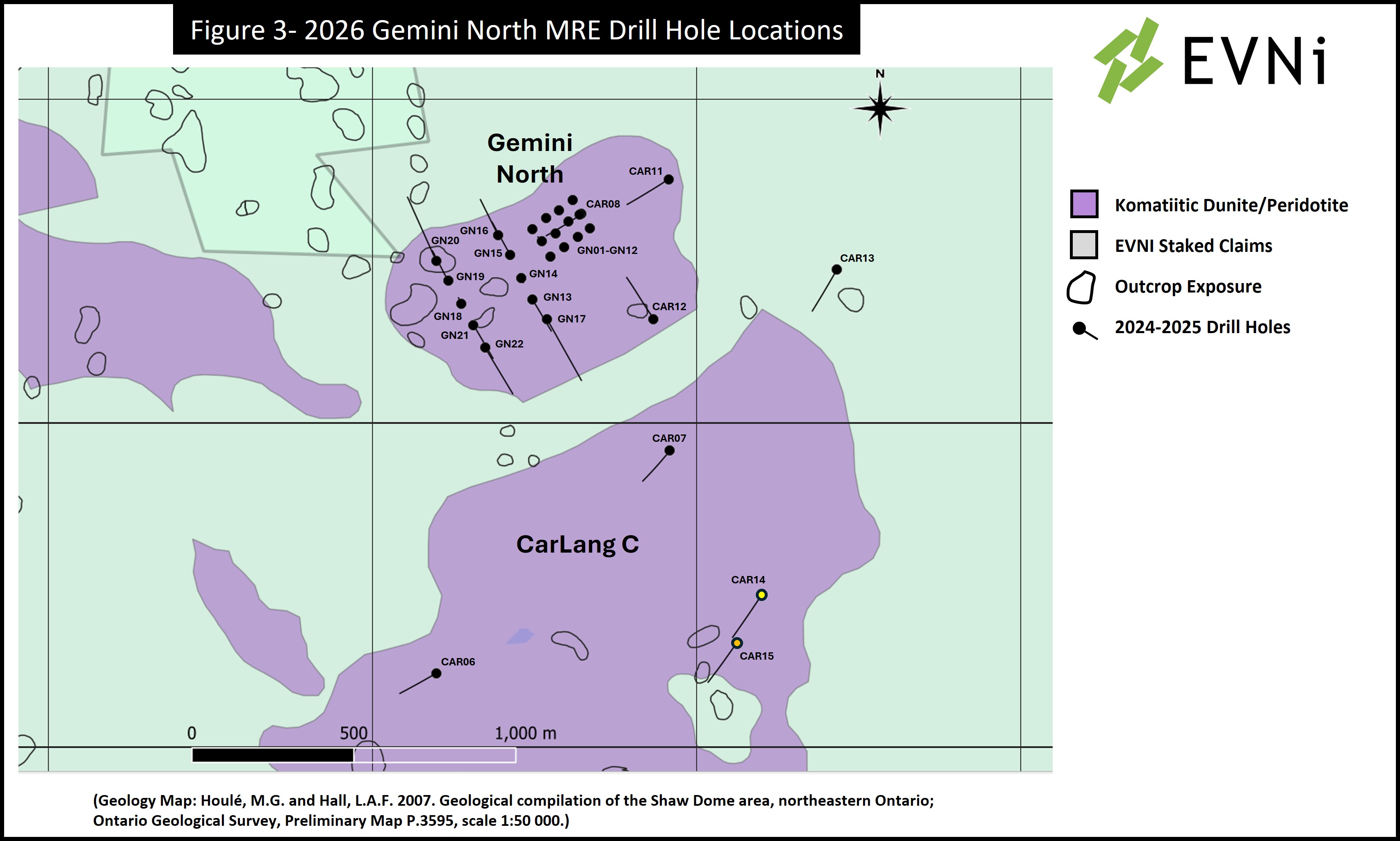
After discovery of the Gemini North Nickel Zone in 2024, EVNi launched a diamond drilling program (23 holes totalling 6,682 m) to complete a maiden mineral resource estimate in accordance with National Instrument 43-101 (“NI 43-101”) which shows Indicated Resources of 9.5M tonnes or 55.6M pounds of contained nickel and Inferred Resources of 84.0M tonnes or 410.7M pounds of contained nickel.
Table 1 – Preliminary Mineral Resource Estimate for the Shaw Dome Project’s Gemini North Nickel Zone.

Notes to Table 1:
1. The independent Qualified Person for the Mineral Resource Estimate, as defined by National Instrument 43-101 – Standards of Disclosure for Mineral Projects (“NI 43-101”), is Dr. Scott Jobin-Bevans (P.Geo., PGO #0183) of Caracle Creek International Consulting Inc. The effective date of the Mineral Resource Estimate is February 26, 2025.
2. The quantity and grade of reported Inferred Mineral Resources in this MRE are uncertain in nature and there has been insufficient exploration to define these Inferred Mineral Resources as Indicated or Measured Mineral Resources. However, it is reasonably expected that the majority of Inferred Mineral Resources could be upgraded to Indicated Mineral Resources with continued exploration.
3. Estimation domains were built from geological data with the exception of high-grade domains which were constrained using grade thresholds based on statistical analysis of the core assays.
4. The Mineral Resource is reported at an NSR break-even cut-off of US$7.35/t based on commodity prices, metallurgical recoveries, selling costs, operating costs, and appropriate mine modifying factors.
5. Geological and block models for the MRE used data from a total of 23 surface drill holes, completed by EV Nickel in 2025. The drill hole database was validated prior to resource estimation and QA/QC checks were made using industry-standard control charts for blanks, core duplicates and commercial certified reference material inserted into assay batches by EV Nickel and by comparison of umpire assays performed at a second laboratory.
6. Estimates have been rounded to two significant figures.
7. The MRE was prepared following the CIM Estimation of Mineral Resources & Mineral Reserves Best Practice Guidelines (November 29, 2019) and the CIM Definition Standards for Mineral Resources & Mineral Reserves (May 19, 2014).
8. A 10 m x 10 m x 10 m block model was created, and samples were composited at 1.5 m intervals. Grade estimation from drill hole data was carried out for Ni, Co, Pd, Pt, Fe and S using the Ordinary Kriging interpolation method in Micromine software.
9. The MRE has been constrained by a conceptual pit envelope that was developed using the following optimization parameters:
• Mining costs and revenues reported in US dollars (US$)
• Metal prices used were US$21,000/t nickel, US$40,000/t cobalt, US$325/t iron, US$3,860/t chromium, US$1,350/oz palladium, and US$1,150/oz platinum.
• Pit slope angle of 45 degrees was applied
• Processing costs and general and administration costs of US$7.35/t for 100 ktpd operation
• Recovery percentage for the metals are: Ni% is 171.63 × S% + 21.2; Co is 11%; Pt is 22%; Pd is 48%; and Fe is 53%.
10. The Mineral Resource statement reports pit-constrained resources using both NiEq and NSR calculated within an optimised open pit. Block value was calculated as:
• NSR ($/t) = NSR_Ni + NSR_Co + NSR_Pt + NSR_Pd + NSR_Fe
• NiEq (%) = Ni% + (Ni%×NSR_Co/NSR_Ni) + (Ni%×NSR_Pt/NSR_Ni) + (Ni%×NSR_Pd/NSR_Ni) + (Ni%×NSR_Fe/NSR_Ni)
The NSR values for each metal was determined using the metal prices and recoveries stated in point 9.
11. Grade estimation was validated by comparison of input and output statistics (Nearest Neighbour and Inverse Distance Squared methods), swath plot analysis, cross-plots of declustered samples against the nearest Ordinary Kriging estimate, and by visual inspection of the assay data, block model, and grade shells in cross-sections.
12. Density estimation is based on referential density information benchmarked from similar deposits and projects. Lithology-specific values were applied: the average estimated density for peridotite, komatiite, and pyroxenite is 2.76 g/cm³ (t/m³).
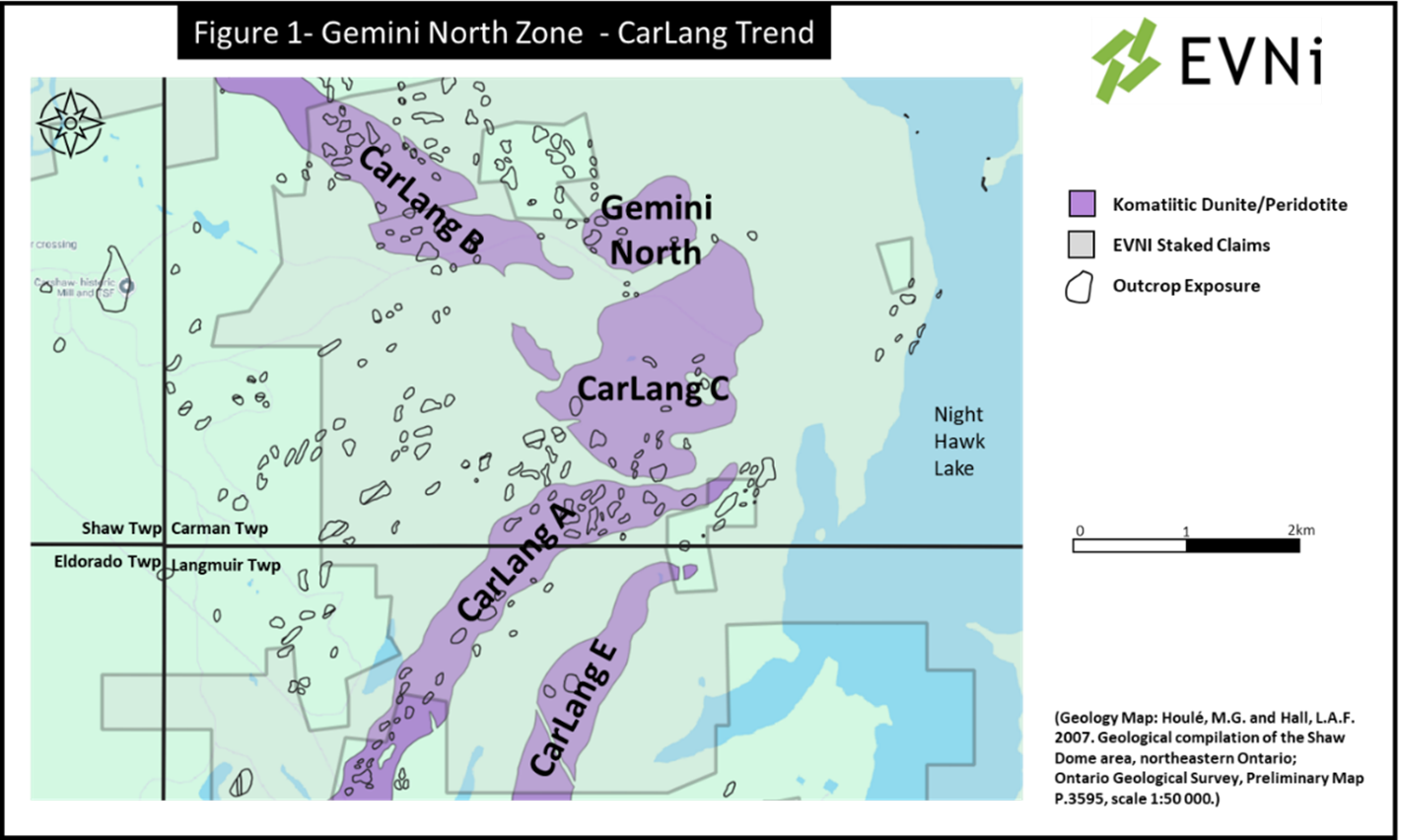
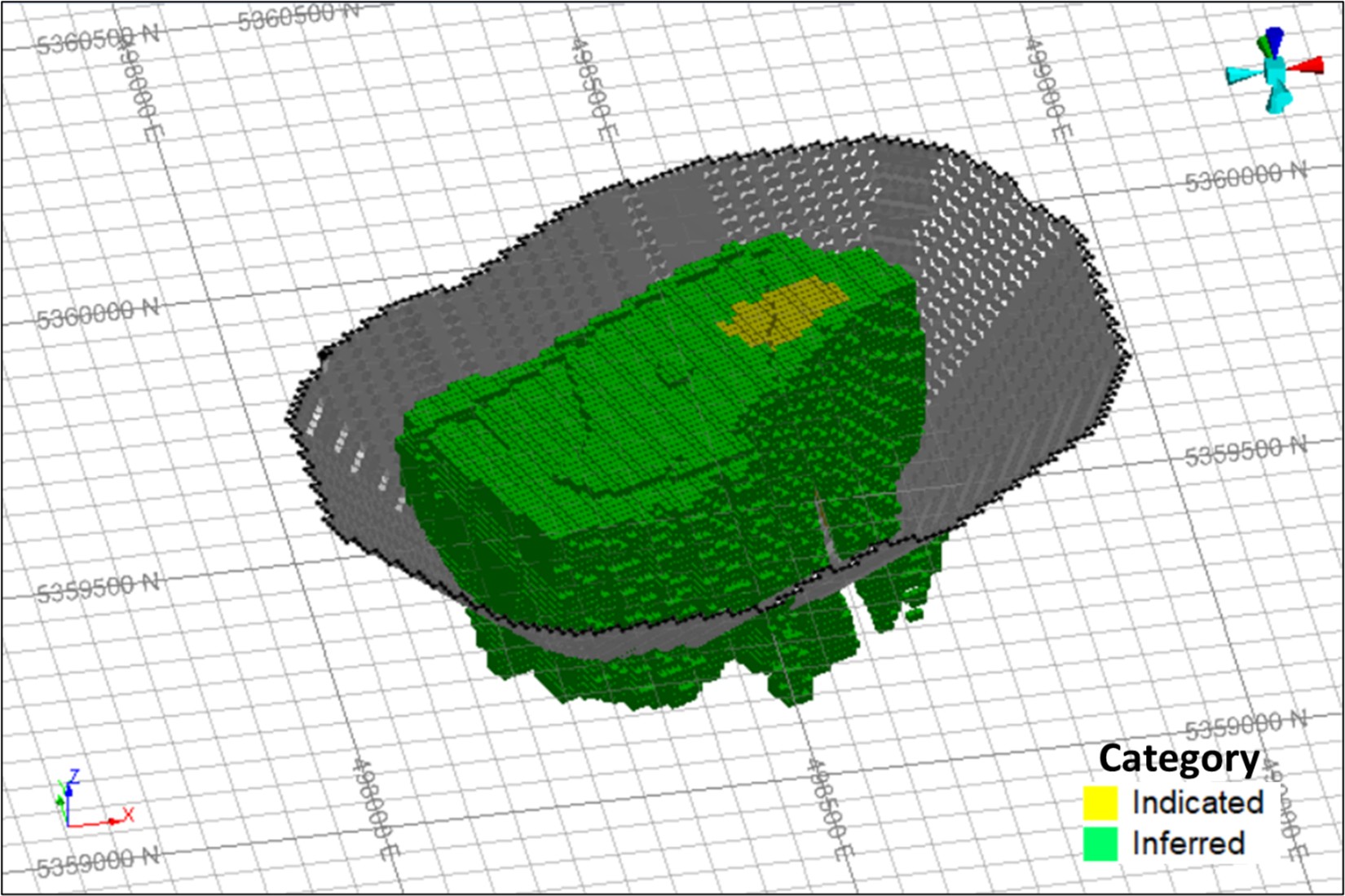
Figure 2: Isometric Viel Showing the pit shell (light grey) with respect to the modelled Indicated and Inferred Resources
A Technical Report in support of the MRE has been filed on SEDAR (www.sedar.com) with an effective as of April 13, 2026.
Shaw Dome - Gemini North Deposit Resource Tech Report